
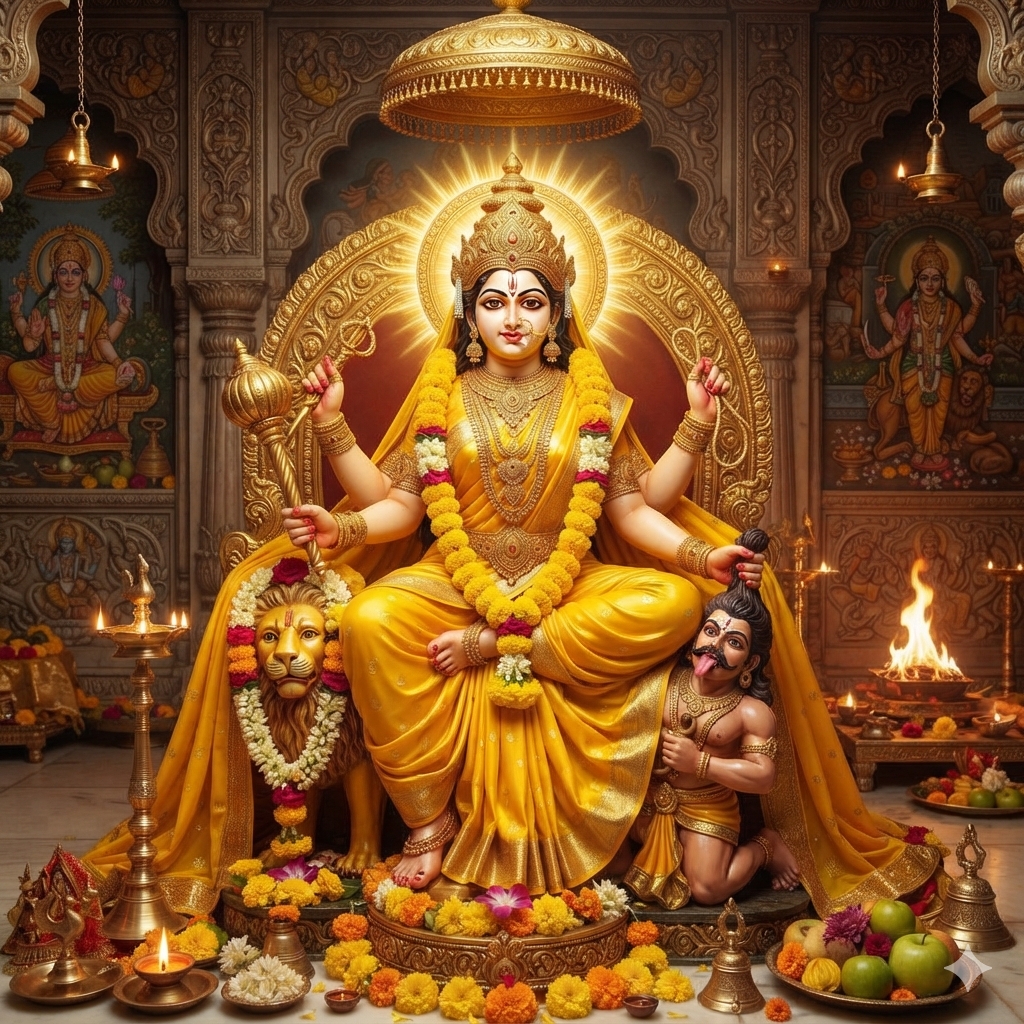
Baglamukhi Sadhana Rules provide traditional guidelines for devotees who wish to worship Maa Baglamukhi, one of the ten Mahavidyas in the Shakta tradition. Known as Pitambari Devi, Maa Baglamukhi holds a special place in Hindu spiritual practices associated with focused speech, self-control, protection, courage and victory over obstacles.
Maa Baglamukhi is traditionally depicted wearing yellow garments and surrounded by yellow ornaments and flowers. Her association with the colour yellow has earned her the name Pitambari, which refers to the one adorned in yellow clothing.
Devotees who follow Maa Baglamukhi worship often pay attention to personal discipline, cleanliness, mantra pronunciation, meditation, offerings and the guidance of a knowledgeable spiritual teacher. These practices help create a calm and respectful environment for prayer.
Baglamukhi Sadhana is part of a rich religious tradition. Different lineages may follow different procedures, mantras, initiation requirements and worship schedules. Therefore, practitioners should understand the distinction between general devotional worship and specialised tantric anushthana.
This guide explains the spiritual significance of Maa Baglamukhi, the traditional importance of yellow, essential preparation rules, commonly recited mantras and precautions for sincere practitioners.
Maa Baglamukhi is worshipped as one of the ten Mahavidyas, the ten great wisdom goddesses associated with Shakta Tantra. Her worship represents the spiritual power to restrain harmful tendencies, overcome confusion and maintain control over speech and actions.
Her name is also associated with the power of stambhana, a Sanskrit term referring to stilling, restraining or bringing something to a halt. In devotional interpretations, this symbolism represents the ability to pause destructive impulses and respond to difficult situations with greater awareness.
Maa Baglamukhi is widely known as Pitambari Devi because yellow is central to her traditional iconography and worship.
The word Pitambara refers to yellow garments. Her images often portray her wearing yellow clothing, yellow ornaments and yellow garlands. Devotees may also offer yellow flowers, turmeric and other suitable yellow-coloured offerings.
Yellow is associated in many Hindu traditions with knowledge, auspiciousness, prosperity, clarity and spiritual discipline. Gold and sunlight also contribute to its symbolic significance.
For devotees, the use of yellow creates a consistent devotional atmosphere and expresses reverence for the goddess.
Maa Baglamukhi represents the importance of restraint, awareness and the disciplined use of personal power.
Her traditional symbolism can be understood through several spiritual principles:
Control over speech: Pause before speaking and avoid words that cause unnecessary harm.
Mental discipline: Recognise distracting thoughts instead of reacting impulsively.
Courage during adversity: Maintain composure when facing conflict or uncertainty.
Discernment: Distinguish constructive action from anger, fear and confusion.
Protection through awareness: Follow ethical choices and avoid actions driven by revenge.
Traditional devotional literature attributes powerful spiritual qualities to Maa Baglamukhi. Individual experiences differ, and no mantra should be presented as a guaranteed method of controlling other people or determining future events.
Yellow is one of the most recognisable features of Maa Baglamukhi worship. Devotees frequently associate the colour with auspiciousness, devotion, concentration and the goddess's traditional form.
In some Baglamukhi worship traditions, devotees wear yellow garments and use a yellow-coloured asana. Yellow flowers and turmeric may also be included among the offerings.
The precise materials depend on the ritual tradition, the availability of suitable items and the instructions of the worshipper's Guru.
Commonly used devotional items include:
Yellow flowers appropriate for worship.
Turmeric, traditionally known as haldi.
A clean yellow cloth for the altar.
A yellow asana for seated prayer.
A suitable rosary, or mala, prescribed for the particular practice.
A clean vessel containing water for ordinary puja.
An image or representation of Maa Baglamukhi.
These items are traditional devotional choices rather than universal requirements for every form of worship.
Turmeric holds an important place in Hindu rituals and is traditionally associated with auspiciousness, purity and sacred ceremonies.
Some practitioners use a turmeric mala for mantra recitation in accordance with their lineage's instructions. Others may use a different rosary suited to their practice.
A rosary should be clean, handled respectfully and used consistently. Practitioners should not assume that every mala requires the same consecration procedure or that a previously used mala is universally unsuitable.
For specialised mantra anushthana, ask a qualified Guru about the appropriate materials and ritual requirements.
Baglamukhi Sadhana Rules differ among religious traditions. The following principles explain the practices commonly associated with disciplined worship while distinguishing devotional customs from lineage-specific tantric instructions.
Select a quiet place where you can pray without unnecessary interruptions. Keep the worship area clean and arrange the image of Maa Baglamukhi respectfully.
A separate room may be helpful when available, but it is not a universal requirement for ordinary devotional worship.
Some traditional practices specify a dedicated room, altar or direction. Follow those instructions when they form part of an established ritual taught by a competent teacher.
Bathing or washing before worship is a common Hindu devotional practice. Wear clean clothes and approach the prayer with a calm mind.
Certain Baglamukhi traditions prescribe yellow garments for particular rituals. For general prayer, devotees can follow their family's or temple's customary practices.
External cleanliness should accompany respectful conduct, patience and sincerity.
Yellow clothing is strongly associated with Pitambari Devi. Practitioners may choose a clean yellow garment when performing a worship procedure that prescribes it.
Some specialised instructions specify a yellow dhoti or other traditional clothing. These requirements should be understood within their particular lineage rather than treated as mandatory for every devotee.
The central purpose of devotional clothing is to express reverence and support concentration.
A clean asana helps establish a consistent place for meditation and mantra recitation.
Yellow asanas are commonly associated with Maa Baglamukhi worship. However, the exact material and colour may vary by tradition.
Sit comfortably, maintain a stable posture and avoid straining your back or knees during extended prayer.
A mala supports consistent mantra counting and focused recitation. Turmeric malas are associated with certain Baglamukhi practices, while other traditions may prescribe different materials.
Some lineages require a specially consecrated mala for a specific anushthana. A practitioner should not independently assume that a ritual rosary has been properly consecrated simply because it has been purchased or used previously.
Ask your Guru which mala is appropriate and how it should be maintained.
Regularity can help devotees establish a meaningful spiritual routine. Choose a realistic time when you can pray without rushing or neglecting essential responsibilities.
Some specialised tantric traditions prescribe night-time practice or specific ritual windows. Other forms of devotional worship take place during the morning or evening.
A fixed night-time schedule, such as 9 p.m. to 4 a.m., should not be treated as a universal rule for every Baglamukhi devotee. Follow a specific timing only when it belongs to the authorised procedure you are practising.
Amavasya, the new-moon day, has significance in several Hindu religious and ancestral observances. Certain tantric lineages also associate particular rituals with this lunar phase.
Some Baglamukhi anushthana instructions recommend beginning on Amavasya. This is a lineage-specific practice rather than an absolute requirement for all forms of Maa Baglamukhi worship.
Before selecting a starting date for an advanced ritual, verify the prescribed tithi, local calendar and instructions with a knowledgeable teacher.
Mantra recitation traditionally involves attention to pronunciation, rhythm and meaning. Repetition should be undertaken respectfully rather than hurriedly.
If a mantra contains Sanskrit sounds that are unfamiliar, learn its pronunciation from a reliable teacher or knowledgeable practitioner.
For beginners, simple devotional prayer may be a more appropriate starting point than an intensive ritual requiring specialised instruction.
Spiritual discipline should support a healthy and responsible life.
Some traditional anushthana instructions include dietary restrictions or prescribed periods of restraint. These requirements vary, and an extreme fasting schedule or a single daily meal is not appropriate for everyone.
Do not compromise hydration, nutrition, sleep, prescribed medication or medical care to fulfil a ritual. Consult a qualified healthcare professional when dietary restrictions may affect your health.
Specialised Baglamukhi tantric practices may involve initiation, ritual preparation, mantra-specific instructions and procedures that are not interchangeable between lineages.
A knowledgeable teacher can explain the purpose of the practice, its limitations and the responsibilities it entails.
Choose a teacher who encourages ethical conduct, informed consent and personal responsibility. Be cautious of anyone who guarantees supernatural results, threatens you with spiritual harm or demands escalating payments for promised siddhi.
A simple devotional routine can help practitioners approach Maa Baglamukhi with sincerity. The following outline is intended for general prayer, not as a substitute for initiation into a specialised tantric ritual.
Prepare a clean surface for the image or representation of Maa Baglamukhi. Arrange suitable offerings without overcrowding the altar.
Sit comfortably and take a few natural, unforced breaths. Set an intention to cultivate clarity, restraint, courage and responsible action.
Offer flowers or other appropriate items according to your tradition. You may express gratitude and ask for wisdom in handling difficult situations.
Use a devotional mantra that you understand and are comfortable reciting. Follow the pronunciation and repetition guidance provided by a trusted source.
Advanced mantras may require initiation or specific instructions. Do not assume that a mantra intended for a specialised ritual is suitable for every practitioner.
Spend a short period in silence. Reflect on how you can apply patience, truthful speech and self-control in daily life.
Offer a final prayer and conclude the session calmly. Keep the worship area tidy and handle ritual materials responsibly.
If you light a lamp, use a stable, heat-resistant holder, keep it away from flammable materials and never leave an open flame unattended.
Baglamukhi worship includes different mantras used in different devotional and tantric settings. Their suitability depends on the practitioner's tradition and the purpose of the ritual.
The following commonly circulated forms are included for educational reference. Their inclusion does not establish that every reader should perform them as an intensive anushthana.
The following mantra is commonly presented as a principal Baglamukhi mantra:
Sanskrit:
ॐ ह्लीं बगलामुखि सर्व दुष्टानां वाचं मुखं पदं स्तम्भय जिह्वां कीलय बुद्धिं विनाशय ह्लीं फट्॥
Transliteration:
Om Hleem Bagalamukhi Sarva Dushtanam Vacham Mukham Padam Stambhaya Jihvam Keelaya Buddhim Vinashaya Hleem Phat.
This mantra is associated with the traditional symbolism of stambhana, or restraint. Its wording invokes the goddess in relation to speech, expression and mental faculties.
The mantra is interpreted differently across traditions. Readers should consult a knowledgeable teacher for its precise ritual meaning, pronunciation and appropriate use.
Some tantric lineages restrict the practice of particular mantras to initiated students. Respect those restrictions when they apply.
A shorter form commonly circulated in devotional materials is:
Sanskrit:
ॐ ह्लीं बगलामुख्यै ह्लीं फट्॥
Transliteration:
Om Hleem Bagalamukhyai Hleem Phat.
This concise mantra invokes Maa Baglamukhi through her name and associated seed syllable.
Devotional traditions may use shorter mantras for focused prayer. The appropriate number of repetitions and any initiation requirements depend on the source and lineage.
Do not assume that a short mantra automatically carries the same ritual requirements or intended use as a longer tantric mantra.
A mantra circulated under the name Dhumavati Samputit Baglamukhi Mantra is:
Sanskrit:
ॐ ह्लीं धूं धूं धूमावत्यै ह्लीं फट्॥
Transliteration:
Om Hleem Dhoom Dhoom Dhumavatyai Hleem Phat.
This form combines seed syllables associated with Baglamukhi and Dhumavati traditions. The term samputit can refer to a particular method of enclosing or combining mantras within a ritual structure, although the exact meaning and procedure depend on the lineage.
The short formula above should not automatically be regarded as a complete samputita ritual. Such practices may require additional instructions, prescribed sequences or initiation.
Maa Dhumavati is another of the ten Mahavidyas. Her worship has its own symbolism and ritual context, which should not be confused with general Baglamukhi devotion.
Mantras are sacred within their respective religious traditions. Before undertaking an intensive practice, verify the exact wording, pronunciation, ritual context and any initiation requirements.
Avoid changing syllables, combining mantras independently or assuming that a published formula represents a complete ritual procedure.
Guru guidance has a significant place in many Hindu tantric traditions because specialised practices can involve complex instructions and responsibilities.
A competent teacher helps the practitioner understand the intended purpose of the ritual and the limits of the instructions being followed.
Some mantra practices are taught through diksha, or initiation. Others are available as general devotional prayers.
These categories should not be treated as interchangeable. A practitioner should establish whether the selected mantra is intended for ordinary worship, personal meditation or a specific initiated anushthana.
A responsible teacher should explain the practice clearly and respect the practitioner's physical, emotional and financial well-being.
Before undertaking an advanced ritual, ask about:
The tradition and source of the mantra.
Whether initiation is required.
The intended duration and daily routine.
Appropriate ritual materials and their handling.
Any dietary or lifestyle restrictions.
The limits of claims concerning spiritual results.
Whether the practice is suitable for your circumstances.
No teacher can responsibly guarantee that a ritual will control another person's behaviour, defeat a particular opponent or produce wealth by a fixed date.
Some published accounts of Baglamukhi Sadhana describe a structured 33-day practice. Such accounts may include fixed timings, particular malas, daily repetition targets and a prescribed sequence of mantras.
These details should be understood as instructions associated with particular traditions, not as universal rules applying to every form of worship.
A prescribed period gives a ritual a defined structure. Repeated practice can also help establish consistency and concentration.
However, there is no universal rule that every Baglamukhi mantra produces siddhi after 11 or 33 days. Spiritual experiences cannot be reliably guaranteed by a fixed count or timetable.
Some anushthana procedures prescribe a particular number of repetitions per session. The number may depend on the mantra, initiation and ritual framework.
For general devotional worship, practitioners should follow a suitable routine rather than adopting demanding repetition targets without preparation.
Dietary restrictions appear in some religious disciplines, but they differ across traditions and individuals.
A single daily meal is not a universal requirement for Baglamukhi worship. Anyone considering fasting or significant dietary restrictions should account for health, medication, physical activity and other responsibilities.
A dedicated space may help maintain concentration during a structured retreat or ritual observance.
However, a universal prohibition against travelling or visiting another location should not be inferred from the existence of specialised ritual instructions. Follow established requirements only when they apply to the particular practice.
Maa Baglamukhi is traditionally associated with victory and the restraint of harmful forces. A thoughtful interpretation also invites devotees to examine their own conduct.
The desire for victory can easily become entangled with anger, jealousy or the wish to dominate others. Ethical spiritual practice encourages practitioners to examine their intentions before taking action.
The symbolism of speech restraint can inspire devotees to avoid gossip, threats, insults and unnecessary arguments.
Before responding to conflict, consider whether your words are truthful, proportionate and constructive.
When facing disputes, combine prayer with practical action. Maintain records, seek professional advice where necessary and use lawful ways to protect your interests.
A spiritual practice should not replace legal remedies, medical treatment, counselling or other appropriate support.
A regular prayer routine may provide a meaningful opportunity for reflection and emotional grounding. Its value can lie in developing patience, awareness and a sense of purpose.
Experiences vary from person to person. Practitioners should avoid interpreting every coincidence, dream or difficulty as proof of supernatural intervention.
Understanding common mistakes can help devotees approach the practice with greater care.
1. Following unrelated instructions together: Different lineages may prescribe different methods. Combining them without understanding their context can cause confusion.
2. Treating online instructions as complete initiation: An article can introduce concepts, but it cannot necessarily provide all the instructions required for an advanced tantric ritual.
3. Expecting guaranteed siddhi: Fixed durations and repetition counts do not establish a guaranteed spiritual outcome.
4. Neglecting health: Avoid unsafe fasting, sleep deprivation or the abandonment of prescribed treatment.
5. Using worship to justify harmful intentions: Focus on protection, discernment and ethical action rather than coercion or retaliation.
6. Ignoring fire safety: Keep lamps and incense away from curtains, paper and other flammable objects. Never leave a burning lamp unattended.
7. Accepting fear-based promises: Be cautious of anyone who claims that a costly ritual is the only way to prevent a curse or avoid inevitable harm.
The main principles include maintaining cleanliness, creating a peaceful worship space, following suitable mantra instructions, practising consistently and respecting the traditions associated with the chosen ritual. Specialised tantric procedures may require initiation and additional guidance.
Maa Baglamukhi is called Pitambari Devi because yellow garments are a defining feature of her traditional iconography. Yellow clothing, flowers and turmeric are associated with her worship in many traditions.
Beginners can start with respectful devotional prayer and simple worship. More specialised tantric practices may require initiation, preparation and guidance from a qualified teacher.
No universal rule requires all Baglamukhi worship to take place at night. Certain tantric traditions prescribe night-time practice, while general devotional prayer may follow other schedules.
Some traditions recommend beginning particular practices on Amavasya. This is not a universal requirement for every form of Baglamukhi worship.
Turmeric malas are associated with some Baglamukhi practices. The appropriate mala depends on the mantra and the instructions of the relevant tradition.
A commonly circulated principal mantra begins with “Om Hleem Bagalamukhi.” The complete wording and its ritual use should be verified through a reliable source, particularly when the practice requires initiation.
It is a formula circulated in connection with Baglamukhi and Dhumavati traditions. The exact meaning of samputit and the complete ritual procedure may vary, so practitioners should consult an authoritative source within their lineage.
No. A 33-day schedule appears in some descriptions of specialised practices, but it does not guarantee siddhi or a particular spiritual experience.
No. A single daily meal is not a universal requirement. Dietary restrictions should be followed only when appropriate to the particular tradition and the practitioner's health.
Common offerings include yellow flowers and turmeric, depending on the local or family tradition. Devotees should use clean, suitable offerings and follow their temple's or teacher's guidance.
No. Prayer may provide personal meaning and support reflection, but disputes may also require communication, legal advice, professional assistance or other practical measures.
Baglamukhi Sadhana Rules reflect a tradition in which mantra, ritual discipline, symbolism and devotion work together. The yellow form of Pitambari Devi, the association with stambhana and the emphasis on speech and restraint make her worship distinctive within the ten Mahavidyas.
Devotees should distinguish simple prayer from specialised tantric anushthana. Ritual timings, mantra counts, initiation and dietary restrictions may differ between lineages.
Approach Maa Baglamukhi with sincerity, ethical intentions and respect for the tradition you follow. Seek qualified guidance when considering advanced practices, and avoid claims that promise guaranteed siddhi or control over other people.
The deeper value of spiritual discipline can be expressed through clearer thinking, responsible speech, patience and courageous action in everyday life.
Seek traditional guidance: If you wish to learn more about Maa Baglamukhi worship, mantra pronunciation or the distinctions between devotional prayer and specialised sadhana, consult a knowledgeable teacher who can explain the relevant tradition and its responsibilities.
Meta Title: Baglamukhi Sadhana Rules: Mantra, Vidhi and Worship Guide
Meta Description: Learn traditional Baglamukhi Sadhana rules, Maa Pitambari worship, yellow offerings, mantra meanings, spiritual discipline, Guru guidance and essential precautions.
Primary Keyword: Baglamukhi Sadhana Rules
Secondary Keywords: Maa Baglamukhi Sadhana, Baglamukhi Mantra, Baglamukhi Sadhana Vidhi, Pitambari Devi, Baglamukhi Puja, Baglamukhi Mantra Jaap, Dasha Mahavidya, Dhumavati Samputit Baglamukhi Mantra, Baglamukhi Guru Guidance.
Search Intent: Informational with a secondary interest in traditional spiritual guidance.